REVIEW · NEW YORK CITY
Hamilton’s Wall Street
Book on Viator →Operated by Hamilton's New York · Bookable on Viator
Follow Hamilton through Lower Manhattan’s power map. This guided walk traces Alexander Hamilton’s rise from Revolutionary-era service to the financial systems that still shape Wall Street, using real stops you can stand in and connect to his life. I love how the route ties the big ideas (credit, banks, finance) to street-level places like Federal Hall and the Trinity Church graveyard. You also get a clear story thread, from Hamilton at Washington’s side to the Wall Street mythos that came after.
Two things I especially liked. First, the Hamilton-focused storytelling is sharp and specific, not just a list of dates. I also like the pacing balance: short stop times at key landmarks, plus time for a bathroom break and a relaxed finish at Fraunces Tavern Museum.
One possible drawback: the tour is mostly walking and the narration is the main event. If you prefer lots of quiet time, or you hate moving even at a “limited to a mile and a half” pace, plan to enjoy the talk or consider a slower add-on afterward.
In This Review
- Key things to know before you go
- Why Hamilton’s Wall Street reads like a story map
- Meeting at South Ferry: the Battery to Wall Street flow
- Federal Hall: where early America met real money problems
- Trinity Church graveyard: Hamilton’s final resting place, handled with respect
- From the Revolution’s toll to Hamilton’s rise
- Wall Street: the myth and the mechanics, side by side
- Fraunces Tavern Museum: an end stop with a human moment
- The guide style that makes the difference (including Jimmy Napoli)
- Price and timing: what $90.43 buys you
- Who this tour fits best
- Should you book Hamilton’s Wall Street?
- FAQ
- How long is Hamilton’s Wall Street?
- Where does the tour start and end?
- What does it cost?
- Is this tour ticket-based and mobile-friendly?
- What stops are included?
- How much walking is involved?
- Is it suitable for most people, and are service animals allowed?
- What are the cancellation terms?
Key things to know before you go
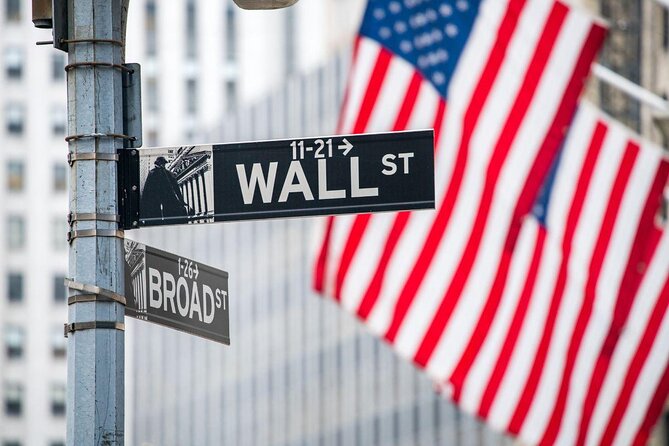
- Hamilton’s story is anchored in places: Federal Hall, Trinity Church, Wall Street, and Fraunces Tavern Museum.
- You get a practical start point near transit, beginning at South Ferry Terminal at 11:00 am.
- Walking stays manageable with a limit of about 1.5 miles total.
- Stop times are short but purposeful, so you keep momentum through Lower Manhattan.
- Guides can be very engaging, with performances that hold both history fans and Hamilton fans.
- Small groups of up to 25 help keep it interactive.
Why Hamilton’s Wall Street reads like a story map
Alexander Hamilton didn’t just help write early America. He helped build the financial plumbing that made the country function. What I like about this tour is that it doesn’t treat him like a statue. You see how his work fits the geography around you—then you feel why Wall Street became more than just a street.
The tour frames Hamilton as an engine: ambitious, restless, and focused on modernizing a young nation that was struggling to earn trust. That matters because New York’s financial district can feel like a blur of buildings and banking jargon. Here, you’re given a human lens for what you’re seeing: people, decisions, and consequences.
Also, you’re not stuck in one museum room. You move through Lower Manhattan where the “money” story actually took shape. That’s the payoff: history that makes the modern skyline feel logical, not random.
You can also read our reviews of more tours and experiences in New York City.



Meeting at South Ferry: the Battery to Wall Street flow
The tour starts at South Ferry Terminal, then works its way toward the heart of Wall Street. You’ll end near 60 Wall St, which is convenient if you want to keep exploring afterward without backtracking.
A smart choice here is beginning at the Battery area. The tour uses it to recall how New York paid a real price during the Revolution, and how that context sets up Hamilton’s rise—from an artillery captain to Washington’s right-hand man. That background isn’t just academic. It gives you a reason to care about later financial decisions, because Hamilton’s story is presented as a response to national survival, not just personal ambition.
Logistically, the walk is limited to about 1.5 miles. That’s not “no walking,” but it also isn’t a marathon. It’s the right kind of route for people who want to see a lot without needing a subway hop every ten minutes. And since it’s near public transportation, you can build an easy pre- or post-tour plan around it.
If you show up a little early, you’ll have time to orient yourself before the group gets rolling. Lower Manhattan has a way of making even a short walk feel busy.
Federal Hall: where early America met real money problems
Federal Hall is your first stop, and it’s practical on purpose: there’s a bathroom break here, and admission is free. That matters because your first minutes set the tempo. When you don’t have to hunt for facilities later, you can stay focused on the story you came for.
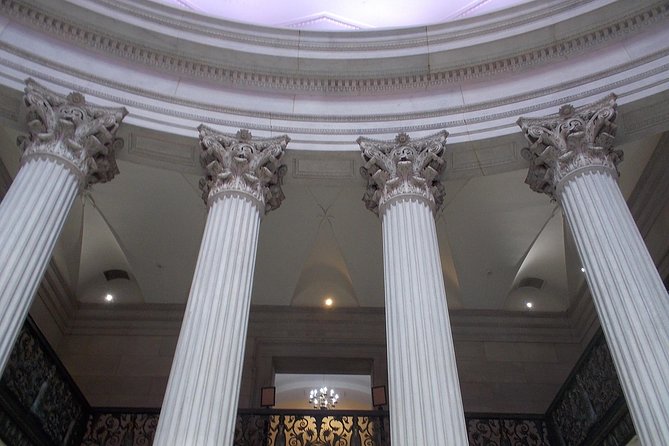
This is also where the tour positions Hamilton’s era as a turning point. Early national systems were fragile. Hamilton helped shape the kind of government credibility that allowed finance to work. Standing at Federal Hall, you can connect the idea of a national government with the lived reality of what it meant to restore trust after financial collapse.
I like that the tour doesn’t treat Hamilton as only a banker. It presents him as someone working through the mess of the time—credit, institutions, and the need to convince people the country would hold together. If you’ve ever wondered why finance became such a political battlefield, this kind of framing makes it click.
One note: since stop time is short, don’t expect a slow, self-guided museum visit. Think of it as a launchpad. If you want to spend more time, you can usually do that on your own afterward.
Trinity Church graveyard: Hamilton’s final resting place, handled with respect
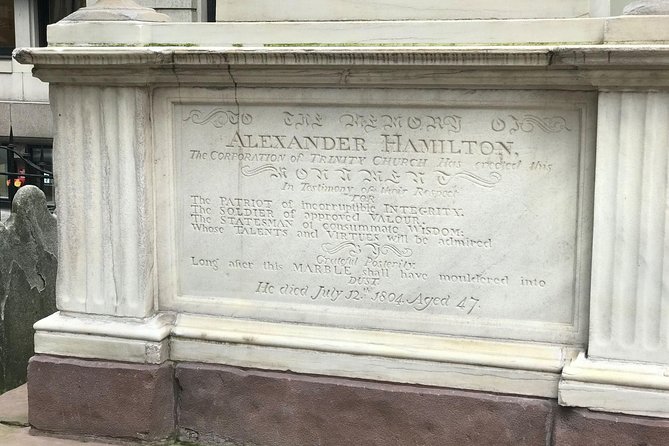
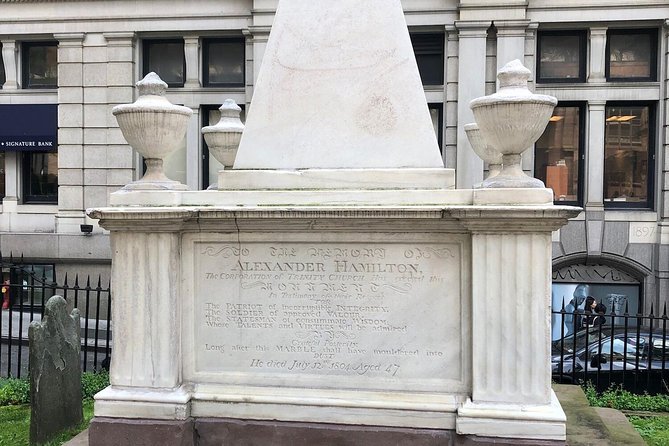
Next comes Trinity Church Wall Street, including a visit to the graveyard. This is one of the most meaningful parts of the tour because it grounds Hamilton’s legacy in something human-scale: a final resting place in the very district tied to his legacy.
The tour’s tone here is about paying tribute and showing respect. That might sound formal, but it changes the feel of the walk. You’re no longer just collecting facts about a founding figure—you’re stopping to recognize that he lived, suffered, argued, and ultimately became part of the nation’s story in a permanent way.
What I like most is how this stop balances the hard edge of Wall Street. The financial district can feel corporate and loud. A quiet graveyard break acts like a reset button. It also helps you understand the contradiction at the center of Hamilton: a man known for speed, ambition, and public battle, now remembered through a place of stillness.
If you’re visiting with kids, this part can work well too. It gives a clear emotional moment in the middle of the facts, so attention has somewhere to land.
From the Revolution’s toll to Hamilton’s rise
The tour starts at the Battery specifically to recall battles of the American Revolution and the toll New York paid for independence during the war. That’s not a random history detour. It’s the setup that explains why Hamilton’s drive mattered so much.
In early America, success wasn’t guaranteed. The country needed leaders who could organize, argue, and build systems under pressure. Hamilton is presented as someone who rose quickly—moving from artillery company captain to the right-hand role beside Washington. That detail isn’t just impressive. It helps you see Hamilton as a builder of momentum, not a passive observer.
Then the tour connects that military-to-political-to-financial line. You hear how Hamilton’s work helped restore national credit to a bankrupt country, and how that fed into the creation of major financial systems. The tour summary also highlights key milestones: the Bank of New York in 1784 and the First National Bank in 1790.
Even if you already know the headlines, it’s useful to get this story stitched together in the places where it unfolded. When you understand the sequence—war pressure, national credibility problems, then institutional solutions—Wall Street stops feeling like a separate universe.





Wall Street: the myth and the mechanics, side by side
Wall Street is the next major stop, and it’s short on the clock, which is exactly right. The goal isn’t to recreate the modern markets in a walking tour. It’s to explain why the name Wall Street became so big it outgrew the physical street.
The tour frames Wall Street as the financial epicenter of American commerce and business. It also points out a key feeling: the street can look small, but the symbolism is enormous. That’s one reason Hamilton matters here. He isn’t presented as a random early figure in a timeline. He’s presented as someone who shaped the financial mindset that later took over the district.
What you’ll probably appreciate is how the tour teaches you to read the district. Instead of seeing only tall buildings and money branding, you start seeing infrastructure: institutions, trust, credit, and the logic of finance. You learn that Wall Street’s power has a backstory, and it isn’t just modern marketing.
Since this is a walking experience with limited mileage, the route keeps you moving. If you want to linger for photos, do it respectfully and close to the group so you don’t fall behind.
Fraunces Tavern Museum: an end stop with a human moment
Fraunces Tavern Museum is where the tour finishes, with a stop at one of Hamilton’s old haunts and time for a drink. Admission is listed as free for the stop, but the drink itself is what makes it feel like more than a history lecture. If you drink, it’s a nice way to mark the end with something easy and social.
This stop works because it shifts you from “where he lived in theory” to “where he lived in real life.” Taverns were community hubs. People argued politics there, traded information there, and processed the day’s stress there. For a founding figure like Hamilton, a space like this fits the personality the tour describes: intensely driven, constantly engaged with public life.
I also like the practical timing. Ending with a drink is a smart use of the final minutes. It gives you a natural off-ramp into your own plans—dinner nearby, theater, or just an unhurried walk to keep seeing Lower Manhattan.
If you don’t drink, you can still treat it as a relaxed finish. The key is that it’s not another tight landmark sprint.
The guide style that makes the difference (including Jimmy Napoli)
A tour can have a great route and still fall flat. This one gets strong marks for the guide voice—especially from Jimmy Napoli, who shows up in multiple accounts as a performer with major Hamilton expertise and quick humor.
The common theme in the praised descriptions is that Jimmy doesn’t just explain. He tells. He keeps people engaged even when the subject turns complex. That’s a big deal for a Hamilton tour, because you’re mixing politics, banking, and Revolutionary history. If those topics are presented like homework, people lose interest fast.
Here’s what I’d expect from a guide like Jimmy: fast momentum, clear storytelling, and room for interaction. People also mention that he makes Hamilton’s years of military and public service feel alive, not distant. That’s the difference between knowing facts and actually understanding how they connect.
One practical note: if you’re sensitive to speed, be aware that the narration can come quickly. If you like to ask lots of questions, it helps to be ready with them. Otherwise, you can still take in the story and catch the details you want afterward.
Price and timing: what $90.43 buys you
The price is $90.43 per person, and the tour runs about 3 hours (around there). In my view, the value depends on what you want from Lower Manhattan.
If your plan is mostly sightseeing selfies and landmark photos, the cost will feel steep. But if you want a narrative that connects Hamilton’s major financial moves—like restoring national credit and founding major banks—to the exact places you’re standing, it starts to make sense fast.
The tour also limits walking to about 1.5 miles. That’s efficient. You don’t spend your limited energy trudging across downtown. Instead, the time goes into story and context.
Group size caps at 25, which usually means you don’t feel like a nameless blur in a crowd. With a guide who’s good at voice and pacing, that matters.
So, who gets the best value? People who enjoy guided storytelling, who care about why history shaped institutions, and who like seeing how the past echoes in modern city life.
Who this tour fits best
This experience is a strong match if you fall into one of these buckets:
- Hamilton fans who want to see the real-world settings behind the musical-era obsession.
- History buffs who like political and financial context, not just battles and monuments.
- Families with kids who can handle listening for a few hours. Accounts include children around 9 to 11 staying engaged, and teens tagging along for Hamilton-related interest.
It may be less ideal if you want a quiet, self-paced walk. This is a talk-forward tour. Also, if you have mobility limits beyond the “limited to a mile and a half” walking range, you’ll want to think carefully before choosing it.
If you’re pairing this with other Lower Manhattan plans, consider scheduling something flexible afterward. The subject matter can spark curiosity, and it’s nice to have time to keep looking at the district without rushing.
Should you book Hamilton’s Wall Street?
Yes, if you want Lower Manhattan with a purpose. This tour is built for people who like being taught a story with real locations—Federal Hall for early national credibility, Trinity Church for a respectful Hamilton stop, Wall Street for the symbolism that outgrew the street, and Fraunces Tavern for a human finish.
I’d book it especially if Hamilton is a current obsession for you or your group, or if you’re tired of generic “Founding Father photos” tours and want connections that make the district feel understandable.
Skip it only if you’re hunting for slow museum time, want a mostly quiet experience, or can’t do steady walking with narration as the main focus.
FAQ
How long is Hamilton’s Wall Street?
It’s about 3 hours (approx.).
Where does the tour start and end?
It starts at South Ferry Terminal (South Ferry Terminal, New York, NY 10004) and ends at 60 Wall St, New York, NY 10005.
What does it cost?
The price is $90.43 per person.
Is this tour ticket-based and mobile-friendly?
Yes. It includes a mobile ticket.
What stops are included?
It includes Federal Hall, Trinity Church Wall Street (including the graveyard), Wall Street, and Fraunces Tavern Museum, with the tour starting at the Battery area.
How much walking is involved?
Walking is limited to about a mile and a half.
Is it suitable for most people, and are service animals allowed?
Most travelers can participate, and service animals are allowed. It’s also near public transportation.
What are the cancellation terms?
You can cancel for free up to 24 hours in advance for a full refund.