REVIEW · NEW YORK CITY
Private New York Tour: Footsteps of Alexander Hamilton
Book on Viator →Operated by Intrepid Urban Adventures - USA · Bookable on Viator
Hamilton’s New York leaves fingerprints everywhere. This private, 2-hour walking tour follows Alexander Hamilton’s life through the most dramatic blocks of Lower Manhattan, from Trinity Church to Wall Street and ending at Fraunces Tavern. You’ll connect his early arrival, rise to power, and complicated end with real landmarks like Federal Hall, the New York Stock Exchange, and Zuccotti Park.
I especially like the private guide format, because it turns a basic history walk into a story you can pace with questions. On this route, guides such as Astrid, Ace Cook, Mickey, and Erik are known for weaving Hamilton’s life with lively on-the-ground details and the present-day money world you’re standing in.
One possible drawback: most of the experience is outside, and you’ll cover about 2.4 km / 1.5 miles on foot. If you’re short on afternoon energy, or you don’t love standing around crowded financial-district corners, plan for plenty of breaks and wear comfortable shoes.
In This Review
- Key highlights
- Following Hamilton Through Lower Manhattan’s Most Important Corners
- Trinity Church Wall Street: Where the Tour Starts With a Timeline
- Trinity Church Cemetery & Mausoleum: Hamilton’s Grave and Family Story
- Zuccotti Park: From Occupy Wall Street to the Neighborhood’s Identity
- Federal Hall: Washington’s Oath Meets Hamilton’s Financial Thinking
- Wall Street’s Built-In Drama: Old Walls, New Skyscrapers
- Fearless Girl and the NYSE: Modern Icons Built for an Old Story
- Stone Street: The Oldest Paved Street Vibe
- Fraunces Tavern Museum: End With Washington and a Real-Life Drink Option
- Private Tour Value at $60: What You’re Really Paying For
- What the Walk Feels Like: Timing, Weather, and Crowd Reality
- Who Should Book This Hamilton Footsteps Walk
- Should you book this Alexander Hamilton walking tour?
- FAQ
- FAQ
- How long is the Alexander Hamilton footsteps walking tour?
- Where does the tour start and where does it end?
- What is the walking distance?
- Is this a private tour?
- Do I need to bring a printed ticket?
- Are drinks included at Fraunces Tavern?
- Which major stops are included?
- Is the tour good for children?
- Does the tour run in bad weather?
- What is the cancellation policy?
Key highlights

- Hamilton’s story mapped onto Lower Manhattan’s biggest “power” addresses, from Trinity Church to the NYSE.
- Federal Hall and Washington’s inauguration on the same walk as Hamilton’s financial ideas that helped shape the modern U.S.
- Wall Street photo stops that include Fearless Girl, plus a clear explanation of how the streets evolved from old fortifications.
- Zuccotti Park’s Occupy Wall Street context, tying past and present activism to the neighborhood’s identity.
- An ending at Fraunces Tavern, where you can grab a drink or dinner if you want to extend the evening (drink not included).
Following Hamilton Through Lower Manhattan’s Most Important Corners
Lower Manhattan can feel like three cities stacked on top of each other: colonial grit, Revolutionary-era politics, and today’s finance machine. This tour is built to stitch those layers together using one person—Alexander Hamilton—so you’re not just looking at famous buildings. You’re watching the city change, block by block, while Hamilton rises from newcomer to one of the architects of the new country.
The “footsteps” idea matters here. Rather than treating Hamilton as a distant figure in a book, you’re walking past places that shaped the decisions he helped drive. And because it’s private, the guide can slow down for the parts you care about most—Hamilton’s political fights, his banking plan, or the Wall Street neighborhood itself.
You meet near Bowling Green by the Charging Bull area and then head into the core stops. That starting point is practical: it’s easy to reach by public transportation and it puts you right where the story begins to crowd in.
You can also read our reviews of more private tours in New York City



Trinity Church Wall Street: Where the Tour Starts With a Timeline

Your first major stop is Trinity Church on Wall Street—one of the oldest church presences in New York. The exterior gives you a sense of permanence in a neighborhood that’s constantly rebuilding itself. The guide connects the site from the late 1600s through today, so you’re not just seeing a landmark—you’re placing it in time.
If you like your history with specifics, this is a good opener. It helps set the “real world” tone early: you’re about to walk through places tied to government, finance, and the people who lived close enough to shape events. The church also gives you a visual anchor before the tour starts moving into the louder, faster-moving Wall Street area.
Trinity Church Cemetery & Mausoleum: Hamilton’s Grave and Family Story
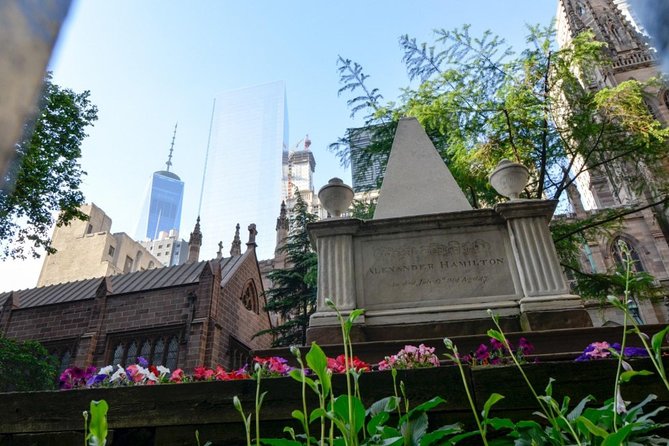
Right next door, you step into Trinity Church Cemetery & Mausoleum, where you can see Hamilton’s monument and learn how the churchyard became the final resting place for major city figures. This stop gives Hamilton a more human shape. It’s not only “founding father heroics”—it’s also family, legacy, and how the city remembers (or tries to remember) people after their lives end.
A big benefit of putting this early in the walk is pacing. You start with “what this city has been,” then you transition into “what Hamilton did inside it.” It’s a clean way to keep the tour from becoming only a list of addresses.
Zuccotti Park: From Occupy Wall Street to the Neighborhood’s Identity

Then you reach Zuccotti Park, the space that became a focal point during Occupy Wall Street in 2011. Even if you don’t follow politics closely, the guide’s explanation helps you understand why this park matters in a Hamilton walk. This part of town has always argued with itself about power—who controls money, who benefits, and who gets heard.
You can also use this moment to reset your feet. The park stop is short, which is helpful because this is where the walking energy starts to matter more than the content. Look around, take a quick pause, and let the guide connect the protest-era feeling to the financial-block geography you’re about to see up close.
Federal Hall: Washington’s Oath Meets Hamilton’s Financial Thinking
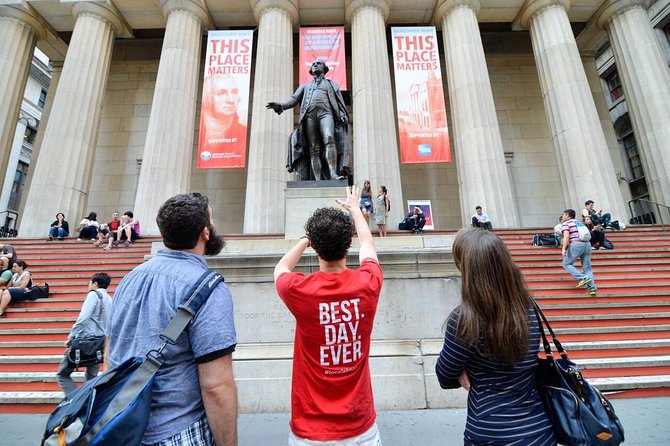
One of the tour’s sharp turns is Federal Hall across from major financial addresses. This is where George Washington was inaugurated, and the building’s role in early U.S. government gives Hamilton’s story extra weight. The guide links the founding-era push for written rights and governing rules to the realities of running a new country.
This stop also helps you understand the “why” behind the money story. Hamilton wasn’t only chasing status—he was trying to solve problems that showed up the moment the U.S. needed stable systems. Seeing a government landmark like Federal Hall while the guide explains Hamilton’s financial plans makes the logic click.
You’ll likely notice the domed structure and later uses of the site as the area’s needs shifted. That physical evolution is a nice reminder that institutions change, but the issues—taxes, credit, national priorities—keep returning.






Wall Street’s Built-In Drama: Old Walls, New Skyscrapers
After Federal Hall, the tour moves onto Wall Street, including explanations about how the street traces back to an earlier wall from the Dutch settlement era. That detail changes how you see the street. Instead of treating Wall Street as only modern towers and trading screens, you understand it as a long-running boundary line—an area people fortified, contested, and then commercialized.
Wall Street also comes with built-in rivalry. You’ll look at a pair of skyscraper landmarks that connect to the famous Hamilton versus Aaron Burr story. One of those buildings includes a Trump name in its branding, which the guide points out as a fun (and slightly uncomfortable) reminder that modern money keeps borrowing historical headlines.
In other words: this is a stop where you’ll want to pause for photos. Not because the view is “pretty,” but because the symbolism is dense. You’re seeing how a street that once meant defense became a place where ambition plays out in glass-and-steel form.
Fearless Girl and the NYSE: Modern Icons Built for an Old Story
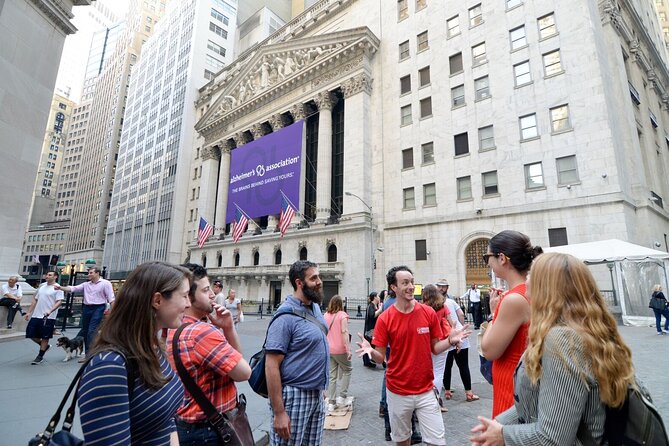
Near the New York Stock Exchange area, you’ll stop for Fearless Girl, the iconic statue positioned across from the Wall Street Bull. It’s a quick photo moment, but the guide’s context makes it land harder than a typical statue stop. The symbolism ties into the tour’s main theme: who speaks up, who controls narratives, and how power tries to look permanent.
Then you reach the New York Stock Exchange itself. The tour is short here, but it’s timed for the emotional payoff. You get a sense of the trading day’s rhythm and the kind of “pulse” the NYSE has for the U.S. economy. Even if you don’t care about markets, standing near that building helps you understand why Hamilton’s financial ideas became such a big deal.
Think of this part as the bridge between founding-era planning and present-day systems. Hamilton helped shape mechanisms for stability and credibility—then today’s institutions take over the job of signaling economic health. It’s the same question, different century.
Stone Street: The Oldest Paved Street Vibe
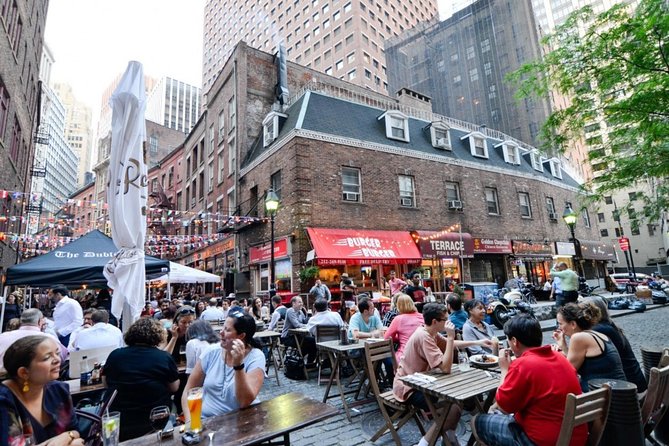
Next comes Stone Street, often described as one of the oldest (and first paved) street experiences in New York. The guide frames it as a walk back toward the city’s earlier European-style feel, which is a helpful counterweight to Wall Street’s sharper angles.
This is where you can breathe. Stone Street slows the pace visually, even when the crowds are still there. If you like “texture” in travel—old materials, street geometry, and buildings that show their age—this stop is worth paying attention to.
You’re also still in Hamilton-land: the neighborhood’s layout and the guide’s pointing-out style helps you recognize how Hamilton’s world was arranged before skyscrapers took over the skyline. It’s not just romantic nostalgia. It’s spatial history.
Fraunces Tavern Museum: End With Washington and a Real-Life Drink Option
The tour ends at Fraunces Tavern on Pearl Street. This is one of the oldest taverns in New York, and the guide ties it to national government gatherings from the late 1780s. The idea of Washington drinking here adds a human scale that history books often skip.
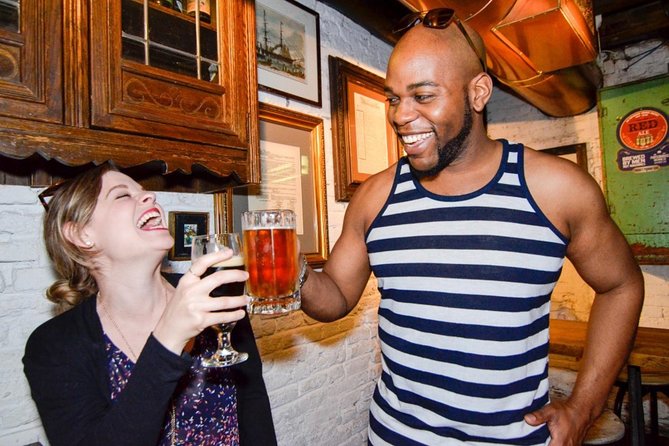
You can raise a glass at the end if you want—drink is not included, but you’re in the right place to make it a longer stop. Since the tour typically wraps after you’ve been standing and walking for about two hours, ending at a tavern is a smart payoff. It also makes it easy for families or groups to decide on the spot whether to continue with dinner or call it a night.
If you’re someone who likes tours to “finish with a plan,” this is a strong ending. Fraunces Tavern gives you a natural next step without needing to research right away.
Private Tour Value at $60: What You’re Really Paying For
At $60 for about two hours, the value depends on how you like to travel. If you enjoy history but hate feeling rushed, a private format helps a lot. You’re not stuck with a large group’s pace, and the guide can tailor emphasis—especially useful if your interest is Hamilton the political thinker, Hamilton the financial organizer, or Hamilton the dramatic Revolutionary-era figure.
You also get practical extras: the guide includes tips on what else to see, do, and eat nearby. That matters in the Financial District area, where it’s easy to waste time searching for something that matches your interests.
One more quiet reason this feels worth it: the route uses a tight set of major sites, so you’re not spending half your time “getting there.” Meeting near the Charging Bull area and walking a compact Lower Manhattan loop keeps the experience focused.
What the Walk Feels Like: Timing, Weather, and Crowd Reality
This tour starts at 2:30 pm and is scheduled to run in rain, shine, or snow unless conditions are dangerous. That means you should treat it like an outdoor experience with indoor breathers, not a museum day.
You’ll cover about 1.5 miles, which is manageable for most fitness levels, but it’s still a real walk with stops that involve standing around. Comfortable shoes are non-negotiable if you want to enjoy the storytelling without your feet stealing the show.
Because the route passes through major landmarks near Wall Street, expect that the area can be busy. The advantage of a private guide is that you’re not coordinating the whole group’s movement at the same speed—your guide can help you keep the flow and timing smooth.
Also note it’s a child-friendly tour, and children under 6 are permitted free of charge. If you’re traveling with kids, the guide’s engaging style can help keep attention from drifting too far.
Who Should Book This Hamilton Footsteps Walk
I’d book this tour if you want Hamilton’s story tied to real places, not only lecture-style history. It’s great if you’ve seen the musical and want the “original-life” context behind the themes you remember. It also works if you’re curious about how U.S. financial systems started to form in the very streets you’re walking now.
It’s especially good for couples, small groups, and families who want a single afternoon activity that feels like a true New York experience. And if you’re the kind of traveler who likes to understand what you’re looking at—why a building matters, why a street layout exists—this tour gives you that.
Should you book this Alexander Hamilton walking tour?
I think this is a solid pick for anyone who enjoys story-driven history in walkable Lower Manhattan. You get a clear Hamilton through-line, key landmarks like Trinity Church, Federal Hall, and the NYSE area, plus an ending at Fraunces Tavern that gives you an easy way to extend the day.
Book it if:
- You want a private, 2-hour walk instead of a long, crowded day.
- You care about the connection between politics and finance in early America.
- You’d like a guide to point out details you’d miss on your own.
Skip it if:
- You hate outdoor walking in busy areas.
- You’re only interested in museums and want minimal street time.
- You’re looking for long time inside sites (this route is mostly exterior and short stop-and-go).
FAQ
FAQ
How long is the Alexander Hamilton footsteps walking tour?
The tour lasts about 2 hours.
Where does the tour start and where does it end?
It starts near Charging Bull in Bowling Green and ends at Fraunces Tavern, 54 Pearl St, New York, NY 10004.
What is the walking distance?
The tour covers about 2.4 km (1.5 mile).
Is this a private tour?
Yes. It’s a private tour/activity, so only your group participates.
Do I need to bring a printed ticket?
No. You’ll use a mobile ticket.
Are drinks included at Fraunces Tavern?
No. Drinks are not included.
Which major stops are included?
Key stops include Trinity Church (exterior), Trinity Church Cemetery & Mausoleum, Zuccotti Park, Federal Hall, Wall Street, Fearless Girl, the New York Stock Exchange area, Stone Street, and Fraunces Tavern.
Is the tour good for children?
It’s child-friendly, and children under 6 can join for free.
Does the tour run in bad weather?
It runs rain, shine, or snow unless the weather creates a dangerous situation.
What is the cancellation policy?
Free cancellation is available up to 24 hours in advance for a full refund. If you cancel less than 24 hours before the start time, there’s no refund.