REVIEW · NEW YORK CITY
City of Contrasts Tour-Manhattan, Bronx, Queens and Brooklyn
Book on Viator →Operated by Royal City Tours LLC · Bookable on Viator
Four boroughs in one smooth day. This City of Contrasts tour strings together classic landmarks and street-level stories across Manhattan, the Bronx, Queens, and Brooklyn. You’re not wrestling with subway transfers; you’re watching the city change as you ride.
I love the air-conditioned vehicle and the fact that you can sit back and let the route do the work. I also love the fast, guided stops that mix big-name icons with highly specific details, like what guides such as Sebastian and Millie tend to highlight at each stop.
One thing to know: this is a “see a lot” format, so most stops are brief. If you want long hangs in one neighborhood, you’ll feel the time limit.
In This Review
- Key highlights worth your attention
- Price and value: what $52 buys across four boroughs
- Where you start, where you end, and how that affects your day
- The Midtown opener: Radio City Music Hall’s Art Deco story
- Top of the Rock: a quick 360-degree orientation tool
- Rockefeller Center and St. Patrick’s Cathedral: classic New York in walkable form
- Upper East Side Madison Avenue: luxury blocks and older street bones
- Harlem at street level: Apollo Theater and Astor Row Houses
- The Bronx shift: rap roots, Yankees, and Joker Stairs in one run
- Joker Stairs: where film became a local landmark
- Yankee Stadium and the old field legacy
- Bronx bodega moment: Cancun Deli Grocery
- Murals as living history: Big Pun and I Love The Bronx
- South Bronx context: Amadou Diallo photo and the neighborhood story
- Queens: Flushing Meadows Corona Park and the Unisphere’s scale
- Unisphere: a 12-story replica that dominates the grounds
- Brooklyn in two moods: waterfront calm, then city energy
- Brooklyn Bridge: the walking payoff
- Little Italy: a cultural reset with food-focused street life
- Guides, group size, and the real feel of the day
- Practical tips so the short stops actually work
- Who should book this tour, and who might want a different plan
- Bottom line: should you book City of Contrasts?
Key highlights worth your attention
- Air-conditioned transport across multiple boroughs, so you skip subway planning
- Iconic Midtown views from Top of the Rock and classic landmarks like Rockefeller Center
- Harlem stops with culture in the foreground, including the Apollo Theater and Astor Row Houses
- Street art and film locations in the Bronx, from murals to Joker Stairs
- World’s Fair landmarks in Queens, especially Flushing Meadows Corona Park and the Unisphere
- Brooklyn walking payoff, with Domino Park and the Brooklyn Bridge area
Price and value: what $52 buys across four boroughs
At $52 per person for about 5 to 6 hours, the value comes from what’s bundled: transport by air-conditioned vehicle plus a professional driver/guide and all the taxes and fees. The math is simple. If you tried to recreate this day on your own, you’d spend time figuring out transfers, and you’d likely pay for separate guided segments to get the same context at the street level.
Also, several stops are listed with free admission (for example, the Apollo Theater and Astor Row Houses are marked as admission ticket free, along with multiple murals and photo stops). That helps your day feel less like a ticket-per-stop approach and more like a guided “walk and look” tour with the scenery and stories doing most of the work.
You can also read our reviews of more city tours in New York City



Where you start, where you end, and how that affects your day
You begin at 790 7th Ave, New York, NY 10019 and finish in a different location at the end of the experience. That matters because you should plan your next activity with some flexibility. In a day that covers Manhattan, the Bronx, Queens, and Brooklyn, you’re not finishing back at the exact same spot like some half-day city loops.
The tour is small enough to stay manageable (maximum 50 travelers) and uses a vehicle size based on reservations. Some groups ride in a smaller van, which can make it feel more personal on the road, especially when the guide is talking through sights as you pass them.
The Midtown opener: Radio City Music Hall’s Art Deco story
The day starts with Radio City Music Hall, a landmark tied to Art Deco glamour and showbiz history. You’ll hear how the Rockettes became a signature act after the venue opened, and how the Radio City Christmas Spectacular has been a tradition since 1933.
Why this stop works early: Midtown can feel like one big blur, especially if it’s your first NYC trip. Starting here gives you a visual anchor before the tour turns into neighborhoods with totally different styles of architecture and street life. It’s also a good reset for photos—wide landmark views beat trying to hunt for a perfect angle mid-shuffle.
If you care about specific show-related details, keep in mind the tour may be timed around what’s accessible. Construction or local conditions can affect what you can see up close, even if the area is still part of the route.
Top of the Rock: a quick 360-degree orientation tool
Next up is Top of the Rock, covering the 67th, 69th, and 70th floors, including indoor and outdoor viewing areas. The point isn’t just photos. It’s orientation.
From those heights, you can connect what you see on the horizon to what you’re about to visit at street level. That helps later stops in Harlem, the Bronx, Queens, and Brooklyn feel less random and more like a map you’re learning in real time.
Practical tip: this is a viewpoint stop, so wear layers if you get cold easily indoors. Bring your camera-ready hands—this kind of view tends to make you want to shoot first and read captions second.
Rockefeller Center and St. Patrick’s Cathedral: classic New York in walkable form

You also get time around Rockefeller Center, including the Rink and the Christmas Tree area. Even if you don’t visit in winter, it’s still one of those places where the geometry and crowds (even when lighter) make it feel like the city is posed for a postcard.
Then comes St. Patrick’s Cathedral, a standout example of Neo-Gothic architecture. It’s described as a spiritual sanctuary, which changes the vibe from sightseeing-only. For me, that balance matters. You’re not just looking up at towers; you’re also seeing a place that still functions as a place of worship.
If you’re sensitive to crowds, aim for slower moments when the group is paused. Cathedral interiors can be visually intense—take your time to notice the architectural rhythm rather than rushing through the highlights.




Upper East Side Madison Avenue: luxury blocks and older street bones
The tour moves through the Upper East Side, with Madison Avenue as a hallmark. Think upscale residential scenery: luxury storefronts, big-branded retail energy, and high-rises standing alongside more traditional brownstone forms.
This stop is useful even if you’re not shopping. It gives you a contrast point. Harlem and the Bronx will come next, and seeing the Upper East Side first helps you understand how quickly the city shifts in rhythm, wealth cues, and street design.
One consideration: if luxury neighborhoods aren’t your thing, use this time to focus on architecture and street layout. You’re building a mental picture of NYC as a collection of neighborhood “systems,” not just a list of famous sights.
Harlem at street level: Apollo Theater and Astor Row Houses
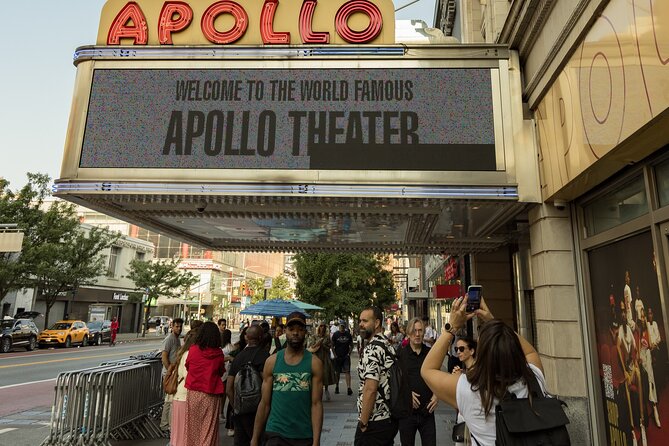
Harlem is where the tour really leans into identity, arts, and community. You’ll hear how the neighborhood is known for its African-American roots, soul food culture, and small jazz clubs, alongside a mix of modern high-rises and 19th-century brownstones.
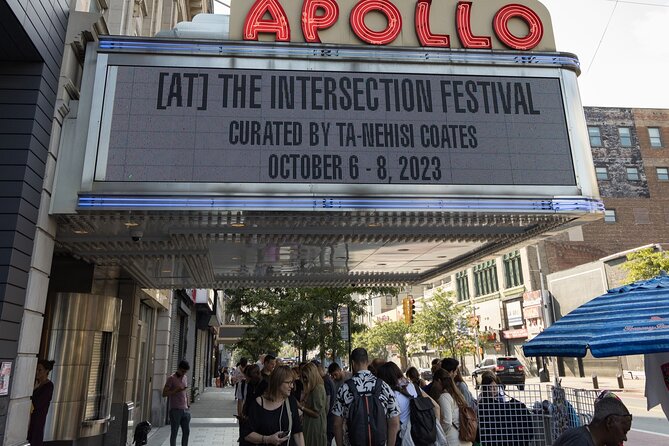
The Apollo Theater is a major anchor. It’s described as one of America’s cultural treasures, with roots dating back to 1934. The Apollo is also framed as a top performing arts organization dedicated to Black innovation and culture, which is a helpful context before you even think about music history.
This is also one of the stops marked admission ticket free, with a 20-minute slot. That time is short, so the goal is to take in the space and the meaning, not to plan for a full deep-dive visit.
Next: Astor Row Houses. These are early speculative townhouses in Harlem, with 28 three-story homes set back from the street. The buildings have brick construction, plus features that are unusual for Manhattan—wooden porches and front and side yards.
That’s the kind of detail that makes a “contrasts” tour feel real. You go from a landmark theater that shaped major cultural moments to quiet residential architecture that shows how Harlem formed at the street level.
The Bronx shift: rap roots, Yankees, and Joker Stairs in one run
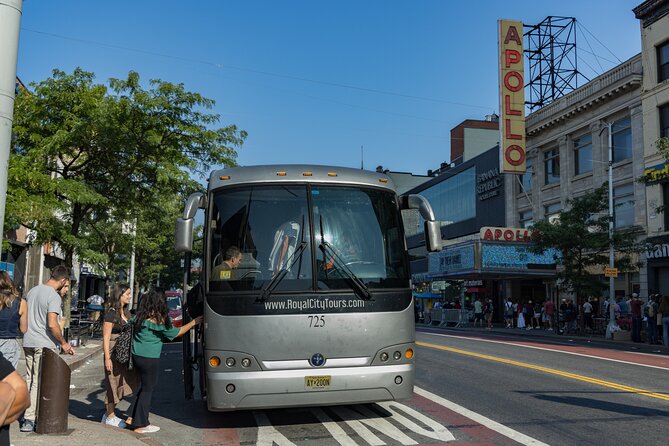
Then you head into the Bronx, introduced through two common frames: the New York Yankees and the Bronx as a cradle of rap and hip-hop. You’ll feel that theme in how the stops are chosen—sports mythology and music culture side by side.
Joker Stairs: where film became a local landmark
A standout stop is Joker Stairs, tied to filming locations from Joker (2019) and Joker: Folie à Deux (2024). The stairs are now part of the list of famous film locations.
Why it works on a tour like this: it turns a mundane streetscape into a recognizable story spot. Even if you don’t know the movies, you’re still learning how pop culture can put a neighborhood on the wider map.
Yankee Stadium and the old field legacy
You’ll also see Yankee Stadium and the Old Yankee Stadium Field area. The data here is clear: Old Yankee Stadium operated from 1923 to 2008, and it was replaced by the current Yankee Stadium, which opened in April 2009.
If you’re a baseball fan, this stop gives you a clean sense of time. If you’re not, it still offers a major NYC anchor point and a reminder that sports venues aren’t just modern buildings—they’re built on layers of the city’s memory.
Bronx bodega moment: Cancun Deli Grocery
Next comes a typical Bronx bodega, with Cancun Deli Grocery listed as the stop. Bodegas are described as small independent groceries with ethnic foods or regional cuisine, plus distinctive signage and individual character.
This is one of those “you’ll never get this from a guidebook photo-only walk” stops. It’s not about buying anything. It’s about understanding the everyday places that keep neighborhoods running.
Murals as living history: Big Pun and I Love The Bronx
The Bronx portion also brings you face-to-face with murals that work like public memory.
You’ll stop at the Big Pun Mural, created by the artist collective Tats Cru, honoring Christopher Rios, also known as Big Pun. Another mural stop is I Love The Bronx by Tats Cru as well, where each letter is said to represent a different Bronx characteristic.
These mural stops have short time windows, but they’re powerful for two reasons:
1) They show art as community work, not just decoration.
2) They connect music and identity to a physical place you can actually stand in.
If you care about urban art, bring a little extra patience. You’ll want to read details and compare lettering, styles, and how the mural fits the block.
South Bronx context: Amadou Diallo photo and the neighborhood story
The tour also includes a stop featuring a photograph of Amadou Diallo painted on a building on Wheeler Avenue, near the location where he was shot and murdered by 41 police bullets. That’s a heavy moment in an otherwise fast-paced route, but it’s part of the neighborhood storytelling approach.
The tour also frames the South Bronx across decades—how it came to represent urban decay from the 1960s through the 1990s, while also being described as a cradle of hip-hop and graffiti.
This is where a “contrasts” tour earns its name. It doesn’t only show the shiny version of NYC or the tourism-friendly highlights. You’re also seeing the city’s hard truths, directly in public space.
Queens: Flushing Meadows Corona Park and the Unisphere’s scale
Queens enters with a quick grounding: it’s described as the largest and easternmost of NYC’s five boroughs, named for Queen and Portuguese royal princess Catherine of Braganza.
Then you’re in Flushing Meadows Corona Park, one of the city’s most famous parks. It hosted two World’s Fairs in the 20th century, and it’s described as an area with plenty to do—sports, activities, trails, and historic hikes. The park is also called out as a frequent filming location.
The tour adds Citi Field, home of the New York Mets, and the USTA Billie Jean King National Tennis Center. Even if you’re not visiting for events, it’s useful context to understand how Queens holds major sports infrastructure and big public venues.
Unisphere: a 12-story replica that dominates the grounds
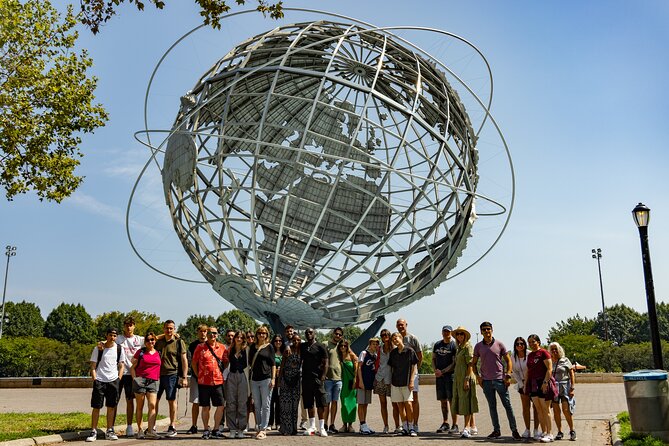
At Unisphere, you get a very concrete World’s Fair landmark: a 12-story stainless steel replica of Earth, designed and built for the 1964–1965 New York World’s Fair. It’s listed as 140 feet high and 900,000 pounds.
This isn’t a “quick photo and forget” stop. The sheer scale helps you understand why people remember this park. It also gives you another contrast point: you’re moving from city districts with dense street grids to a massive park designed for spectacle.
Brooklyn in two moods: waterfront calm, then city energy
Brooklyn is introduced as the most populated borough and one of the most ethnically diverse, with notable communities including Hasidic Jews, Caribbean-Americans, Latinos, and Italians.
The first Brooklyn feel is calmer: Domino Park in Williamsburg. It’s described as a five-acre public park beside the East River. You’ll get time for a leisure stroll and peaceful break, plus views of the Manhattan skyline.
Then you shift to Williamsburg itself. Williamsburg is described as trendy, with stylish shops and hip cafés, plus a strong Hasidic Jewish community. That mixed tone is the point: Brooklyn isn’t one thing. It’s a set of different worlds meeting within walking distance.
Brooklyn Bridge: the walking payoff
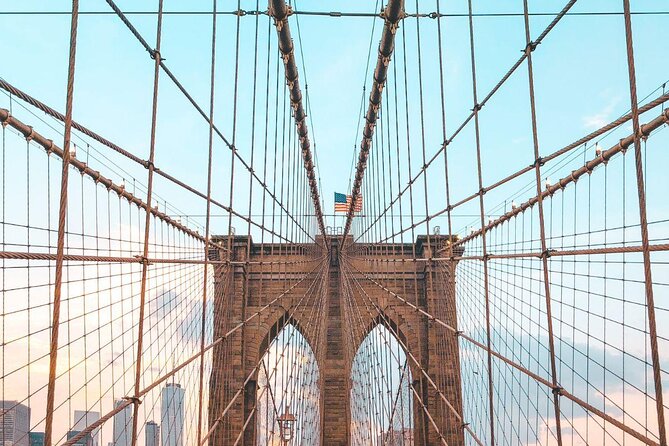
You’ll also include time around the Brooklyn Bridge, which is called one of NYC’s most iconic landmarks. Even if you don’t plan a full crossing, this stop is often the emotional “finish line” moment of the tour day.
A bridge walk changes the perspective in a way vehicle sightseeing can’t. You get wind, sound, and that slow reveal of the skyline as you move.
Little Italy: a cultural reset with food-focused street life
Finally, the tour includes Little Italy and specifically Mulberry Street as the main thoroughfare. The area is described as strongly associated with Italian-American culture, cuisine, and traditions, lined with restaurants, cafés, pastry shops, and markets.
This stop is short, but it works as a practical finish if you want a place to continue your day after the tour ends. Even if you don’t eat, it’s a clear view into how NYC neighborhoods keep culture visible through storefronts.
Guides, group size, and the real feel of the day
The experience is described as having a maximum of 50 people, with vehicle size depending on reservations. In practice, smaller vehicles can help you hear explanations clearly and get a little more personal pacing at stops.
Two guide names show up in the strongest way: Sebastian and Millie (and Daniel is also mentioned). The common thread is that the guide is actively explaining what you’re looking at as you travel, not just reading facts at the curb.
That’s what makes the contrasts land. You’re not just seeing places. You’re learning how the places connect.
Practical tips so the short stops actually work
A tour like this gives you “moments,” not full-day neighborhood immersion. So you’ll get the most by preparing for quick hits.
- Wear comfortable shoes. You’ll get out for multiple short stops.
- Bring a light layer. Viewpoints and parks can shift temperature quickly.
- Plan for no onboard restroom guarantee. Restrooms may not be available on the vehicle.
- Avoid big luggage. The tour notes no suitcases or large bags, and a $10 per bag fee may apply.
Also, seating is enforced: each traveler must have their own seat, and babies may not sit on laps. Seats are guaranteed, but parties may be seated separately depending on vehicle setup.
Who should book this tour, and who might want a different plan
This is a great fit if you want a fast, guided sampler of NYC beyond Manhattan. It’s also smart if you’ve visited before and feel like you’ve “seen the usual” from standard bus loops.
It’s less ideal if you want deep time at one place—like a long museum visit, a full Broadway-style theater experience, or a multi-hour neighborhood stroll. In a day built on short stops, you’ll get context, but not hours of free exploration at every site.
Bottom line: should you book City of Contrasts?
If you want big skyline views, Harlem culture anchors, Bronx street art, Queens World’s Fair landmarks, and Brooklyn waterfront/bridge energy in one managed day, this is a strong option for the price. It’s also been rated 4.7/5 with a 91% recommendation rate, which usually means the core experience lands well for most people.
Book it when you have limited time in NYC and you want your first impression of the boroughs to be guided and specific. Skip it if your trip style requires long, quiet time in just one neighborhood.