Hell’s Kitchen has stories on every corner. This 2.5-hour walk gives you the neighborhood in real-world order: 15 stops, a local guide with lived-in angles, and a hands-on twist with fan clacking.
What I really liked is the mix of facts and play. You get two standout perks right away: an interactive quiz game to keep your brain switched on, and a small group (max 12) that makes it easier to ask questions and actually hear the details.
The main drawback to plan for is simple: you’ll be walking a good stretch at a steady pace, so it is not for you if you struggle with long distances or standing.
In This Review
- Key highlights before you go
- Hell’s Kitchen on foot: what makes this tour work
- Meet BFAB and why the small group matters
- Interactive moments: quiz prize and fan clacking practice
- The walk itself: how the route hits the themes
- German Church and Hartley House: older structures you can still feel
- Tenement-style blocks and late-1800s row houses
- Manhattan Plaza, Westside Theater, and the performance side of town
- LGBTQ+ history you can actually point to
- Walking pace, weather, and what to bring
- Price and value: is $69 fair for what you get?
- Where you start and where you finish
- Who should book this Hell’s Kitchen walk
- Should you book the Fabulous Hell’s Kitchen Walking Tour?
- FAQ
- How long is the Fabulous Hells Kitchen Walking Tour?
- What is the price of the tour?
- Where does the tour start and end?
- What is included in the price?
- Is public transportation included?
- Do I need to bring water and snacks?
- How many people are on the tour?
- Is the tour canceled for bad weather?
Key highlights before you go
- BFAB as your guide: a long-time local with fast, colorful storytelling
- 15 stops in about 2.5 hours: enough time to connect the dots without feeling dragged
- Quiz game with a prize: friendly competition that breaks up the walking
- Fan clacking tutorial: a fun, specific bit of performance culture
- Stops built around real places: German Church, Hartley House, Manhattan Plaza, Westside Theater, Fountain House, and late-1800s tenements/row houses
Hell’s Kitchen on foot: what makes this tour work
Hell’s Kitchen can feel like just another slice of Midtown until you slow down and learn the place names that shaped people’s lives. This tour is set up to do that. You start in the grid of West 42nd Street and end up near West 51st, with a route built around key sites and the way the neighborhood changed over time.
The biggest difference here is that the pace is controlled. The guide keeps you moving, but not in a frantic way. And because the group is capped at 12, you do not get swallowed by the crowd. I like tours like this because you leave with connections—gang life, immigrant life, LGBTQ+ nightlife and community organizations—rather than a pile of random facts.
Two practical details also help: you get a photo-taking service, and the guide carries sunscreen plus a phone charging bank. Those are small things, but they matter on a sunny day (or when your phone battery starts doing its best impression of a dead fish).
You can also read our reviews of more walking tours in New York City



Meet BFAB and why the small group matters
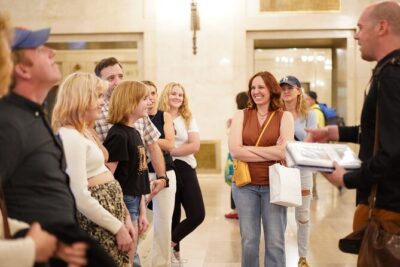
Your guide on this tour is BFAB, and he runs the show like he’s showing friends around. The best part of a great neighborhood guide is the human scale: you get stories that sound like someone who has walked these blocks for years. He also uses the “know the area” advantage in a practical way, pointing out what to notice and how to read the neighborhood as you go.
The small group limit—up to 12 participants—is not just marketing. It changes the whole tone. You can hear the guide, you can ask questions, and the quiz and interaction actually feel like part of the experience instead of a brief interruption.
You should also know this is not a sit-and-sprint tour. It is designed for moderate walking, with a duration around 2 hours 30 minutes. That time window is long enough to learn, but short enough that you do not feel like you missed half your afternoon to do it.
Interactive moments: quiz prize and fan clacking practice
This is a walking tour, but it does not treat you like you’re only there to listen. There are two interactive elements that make the neighborhood stick in your memory.
First: the quiz game with a prize. It is a fun pressure release. Instead of trying to memorize everything, you start paying attention because you want to win. Even if you are not competitive, it gives you a reason to listen for the details the guide wants you to catch.
Second: the tutorial on fan clacking. This is the kind of specific, slightly odd detail that makes a tour feel real. It is connected to performance and LGBTQ+ culture in Hell’s Kitchen, and the guide turns it into something you can learn and laugh about. It also breaks up the walking rhythm so you are not just staring at buildings for two and a half hours.
If you like history that comes with color and some play, this part is a big reason to book.
The walk itself: how the route hits the themes
You cover about 15 stops during the tour, and the route is built around the neighborhood’s turning points: working-class immigrant roots, name origin, gangster-run slums, then later shifts into a multi-cultural arts scene and a well-known gay enclave.
You also get the guide’s habit of connecting past and present. You’ll hear stories that range from the tough realities of gangs and tragedy to the way LGBTQ+ nightlife and community spaces took shape. That range is important. Hell’s Kitchen isn’t one mood. This tour treats it like a place where different eras overlap.
And yes, it can get a bit dramatic in the way that urban legends often do. You get the “colorful stories” angle, including murders and gang conflict, but framed in a way that helps you understand why people built communities here—and why the neighborhood’s reputation changed over time.
German Church and Hartley House: older structures you can still feel
Some neighborhoods have modern facades. Hell’s Kitchen has survival. A key part of this tour is hitting older buildings and seeing the neighborhood’s physical continuity.
Two of the notable stops include the German Church and Hartley House. These are the kinds of locations that make history tangible. Instead of talking about the past as a concept, the guide uses these real landmarks to explain the neighborhood’s immigrant working-class background and how institutions fit into daily life.
Hartley House, in particular, is one of those places that points you toward how communities organized themselves. You are not just hearing about conflict. You’re learning about the social infrastructure that helped people endure and build.
If you like architecture in a practical way—like, what these places likely meant to the people living around them—this is where the tour starts clicking.





Tenement-style blocks and late-1800s row houses
You also spend time on the built environment that helped define Hell’s Kitchen’s reputation in earlier decades: tenement houses typical of the late 1800s and row houses that also date back to that era.
This is valuable because it explains why the neighborhood could shift so quickly. Dense housing and crowded streets shape everything: neighborhood economics, street life, and the way news and rumors spread. When the guide points these out, you start to understand the logic behind the gang era reputation without needing to romanticize it.
A helpful mindset: treat these stops as “context anchors.” They are not just old buildings. They are why certain stories could happen here, and why later life—arts, performance, LGBTQ+ community—could take root too.
Manhattan Plaza, Westside Theater, and the performance side of town
Hell’s Kitchen has always had a performer’s energy, even when conditions were rough. Part of the tour route leans into that, and three stops that fit the theme are Manhattan Plaza, the Westside Theater, and Fountain House.
Manhattan Plaza gives you a sense of how the neighborhood evolved in more modern phases. The guide helps connect that to earlier patterns: change in housing and institutions, then change in who the neighborhood attracted and how it functioned.
The Westside Theater connects performance culture to place. This matters because the neighborhood’s evolution into a multi-cultural artistic area was not abstract. It happened in real venues and street-level communities.
Fountain House adds another layer. You get a view of how long-term community work and public-facing spaces shaped life here. If you want Hell’s Kitchen without the usual “only nightlife” angle, these stops help balance the story.
LGBTQ+ history you can actually point to
A major selling point of this tour is that it takes the LGBTQ+ story seriously and gives it street-level form. You do not just hear general statements. You learn about the neighborhood’s gay past and present, including LGBTQ+ community organizations that left a mark.
This is one of those details that makes the tour feel respectful. The guide ties the LGBTQ+ narrative to specific places and community spaces, so you can see the difference between a neighborhood that attracts nightlife and one that builds community.
The fan clacking tutorial also plays into this theme. It is not random showmanship. It signals performance identity and social culture—things that help explain why Hell’s Kitchen became a recognized haven.
If LGBTQ+ history is on your trip checklist, this tour gives you more than a passing mention.
Walking pace, weather, and what to bring
The experience is listed for people with moderate physical fitness. You should be ready for a steady walking rhythm for about 2.5 hours. One of the reviews references walking around 1.6 miles, which sounds about right for this length of tour without being a painful slog.
What you should bring:
- Water (bottled water is not included)
- Snacks (not included)
- Comfortable walking shoes
- Sunscreen if you have it, though the guide carries some just in case
Weather matters too. This kind of tour needs decent conditions. If it looks like the sky will ruin your afternoon, have a flexible mindset so you can switch to another date if needed.
Also, the meeting and end points mean you are not hopping subway stations every five minutes. You are doing a straight walk with a defined start and finish, and you get to keep your energy for the sights instead of transit logistics.
Price and value: is $69 fair for what you get?
At $69 for roughly 2 hours 30 minutes, this is not a budget “grab-and-go” tour. But it also is not overpriced for what’s included.
Here’s why it can feel fair:
- You get a licensed local guide with in-depth neighborhood storytelling
- You visit 15 stops and cover multiple major themes in one route
- You get photo-taking service, plus the guide provides sunscreen and a mobile phone charger
- You get real interaction: quiz game and the fan clacking tutorial
- The group cap at 12 increases the chance you’ll actually hear and participate
When you compare it to tours that cost more but feel rushed or packed, the small group and included interaction are the value drivers here.
One cost to plan for: public transportation is not included (listed at $5.80 per person). Food and snacks are also not included, so you’ll want to eat before or after the tour.
Bottom line: if you care about neighborhood context and you want a more personal feel, the price makes sense.
Where you start and where you finish
You start at 401 W 42nd St, New York, NY 10036. The tour ends at FLEX405 W 51st St, New York, NY 10019.
That end point is convenient if you want to keep exploring on your own right away. It also helps you plan dinner afterward without doing a long scramble across Midtown.
The start time is 2:30 pm, which is a nice slot if you want a daytime walk and then a relaxed evening plan.
Who should book this Hell’s Kitchen walk
This is a great fit if you:
- Like local guides who tell stories with personality and structure
- Want Hell’s Kitchen history that connects to LGBTQ+ culture
- Enjoy interactive moments like a quiz and a quick performance-style tutorial
- Prefer a small group over large bus-style tours
It’s not your best match if you:
- Have trouble with long walking distances or prolonged standing
- Want a low-effort tour with minimal interaction and no walking rhythm to speak of
Also, if you’re the type who wants one “anchor experience” that helps you understand Midtown’s neighborhoods better, this tour does that. You’ll leave with a mental map of what mattered, and why.
Should you book the Fabulous Hell’s Kitchen Walking Tour?
I think you should book it if your goal is to understand Hell’s Kitchen as a real community over time, not just a set of street names. The combo of BFAB’s storytelling, the small group feel, and the specific cultural stop points (including LGBTQ+ community context) makes it more useful than a generic overview.
Just make sure you come prepared for a real walking afternoon. Bring water and snacks, wear good shoes, and plan to spend the rest of the day using what you learned to explore the blocks around your finish point.
If that sounds like your style, this is a strong way to spend an afternoon in Midtown.
FAQ
How long is the Fabulous Hells Kitchen Walking Tour?
It runs for about 2 hours 30 minutes.
What is the price of the tour?
The tour price is $69.
Where does the tour start and end?
It starts at 401 W 42nd St, New York, NY 10036, and ends at FLEX bar at 405 W 51st St, New York, NY 10019.
What is included in the price?
Included items are a licensed local guide, photo taking service, an interactive quiz game with a prize, a tutorial on fan clacking, tips and recommendations, sunscreen, and a mobile phone charger carried by the guide.
Is public transportation included?
No. Public transportation is not included, and it’s listed as $5.80 per person.
Do I need to bring water and snacks?
Yes. Bottled water and snacks are not included, so you’ll want to bring your own.
How many people are on the tour?
The tour has a maximum of 12 travelers.
Is the tour canceled for bad weather?
Yes. It requires good weather. If it’s canceled due to poor weather, you’ll be offered a different date or a full refund.