REVIEW · NEW YORK CITY
Midtown Manhattan Art and Architecture Walking Tour
Book on Viator →Operated by Manhattan Unlocked Historical and Architectural Walking Tours · Bookable on Viator
Midtown can feel like one long blur of towers. This walk slows it down, showing how art and architecture connect to zoning rules and the city’s power players, block by block. You start near Times Square, then move north toward St. Patrick’s Cathedral with plenty of chances to look up, look through, and look around.
I especially like how the guide turns POPS (Privately Owned Public Spaces) into something you can actually spot and understand. I also like the group size: when it’s capped at five people or less, the pacing stays human and questions don’t get lost.
The one thing to consider is the stamina: it’s still a walking tour with a moderate fitness level, and you’ll be on your feet for a couple of hours while moving through urban space that changes from street to lobbies to passageways.
In This Review
- Key things that make this Midtown walk worth your time
- Walking Midtown by zoning, not by street names
- Price and time: a $59 walk that spends money where it matters
- The small-group advantage: five people, real conversation, better pacing
- Stop 1: Eighth Avenue—how Midtown got built “up”
- Stop 2: 350 W 50th St—Matt Mullican under the city
- CitizenM to the skyline scan: Times Square with a planner’s eye
- The Brill Building: when culture crowds the blocks
- 787 7th Avenue and corporate POPS: modern art inside power
- 6 1/2 Avenue and the weird Midtown in-between
- UBS Art Gallery lobby: art in a space that changes day to day
- Time and Life building lobby: stainless steel meets Mondrian’s student
- Monumental POPS: Senju, Kan Yasuda, and La Gran Manzana
- Sixth Avenue and Rockefeller Center: Art Deco transitions into modern
- Radio City Music Hall: why roxy is everywhere
- The Rink and International Building: Light, Atlas, and winter spectacle
- St. Patrick’s Cathedral and Fifth Avenue: architecture as a timeline
- Park Avenue in one walk: from train tracks to major corporate icons
- Christie’s Sculpture Garden: zoning, sculpture, and three French names
- Papillon Bistro and Bar plus the Philip Johnson POPS story
- IBM POPS and the ending shift toward Billionaire’s Row
- Who this Midtown tour is best for
- Should you book: my quick recommendation
- FAQ
- How long is the Midtown Manhattan Art and Architecture Walking Tour?
- Where does the tour start and end?
- What’s the group size limit?
- Is the tour offered in English, and do I need a printed ticket?
- Do I need to pay admission at each stop?
- Does the tour run in bad weather?
- Is there free cancellation?
Key things that make this Midtown walk worth your time
- Zoning explained in plain English while you walk the city it created, from Beaux-Arts excess to ornament-free skyscrapers.
- Private-to-public spaces: you’ll see how corporate lobbies and mid-block arcades act like public rooms.
- Art you can’t easily find on your own, including site-specific public works and big-name artists tied to buildings.
- A skyline-spotting style tour, with quick moments to scan for Hearst Tower and the New York Times Building.
- Rockefeller Center history that’s more than the ice rink, including how the project’s style shifted after Raymond Hood.
- Small group attention, with guides like Robert Amell (Rob) known for answering questions and adjusting the pace.
Walking Midtown by zoning, not by street names
Midtown is famous for its skyline. But what this tour really teaches is how the skyline got made—by rules, negotiations, and design choices that turned certain corners into public spaces. The key idea is POPS, which are privately owned places that are supposed to feel public once you’re inside or through them. When you know what to look for, Midtown stops being random and starts making sense.
The tour’s approach is part architecture basics, part urban planning lecture—but in a way that stays on your feet. You get the big timeline: the historic move uptown, then the jump from academic styles into modern trends, and eventually the move to slimmer towers and cleaner lines. The result is that you’ll read what you’re seeing in real time, not just memorizing facts.
And because the group can be tiny, you can ask follow-ups when something clicks—like why certain buildings look staged, or how “public” becomes a design requirement. In reviews, guides such as Robert Amell (often mentioned as Rob) are praised for taking questions seriously and adding stops when time allows, so the tour feels built around you rather than a rigid script.
You can also read our reviews of more walking tours in New York City



Price and time: a $59 walk that spends money where it matters
At $59 per person for about 2 to 3 hours, the value comes from access and interpretation. You’re not paying to enter museums at each stop—you’re paying for a guide who can connect street-level design choices to the real forces that shaped Midtown.
Most of the listed stops are ticket-free, especially when the tour can bring you into building lobbies and passageways that many people never notice. That’s a big deal in Midtown, where some of the best architecture is inside spaces you’d otherwise walk past without going in.
Duration matters too. A couple of hours isn’t long enough to get bored, but it’s long enough for the guide to build a narrative—from early zoning concepts to modern corporate art—without rushing. You also get a choice of morning or afternoon departures, which helps if you’re trying to coordinate with other plans.
The small-group advantage: five people, real conversation, better pacing
The tour’s max group size of five travelers (and it’s described as ultra-intimate) is not just a comfort perk. It changes the whole experience. With a smaller group, the guide can slow down when you want details, point out subtle transitions, and keep your momentum without turning every stop into a long wait.
You’ll also benefit from the guide’s attention to pacing. In feedback, people highlight that the guide was conscientious about walking speed and breaks. That’s exactly what you want on a Midtown walk—otherwise, you end up speed-walking through points of interest that you can’t actually see.
Another practical point: the tour uses a mobile ticket and operates in all weather conditions (with the usual “dress for it” advice). Midtown can switch from sunny to wet fast, so plan layers and comfortable shoes.
Stop 1: Eighth Avenue—how Midtown got built “up”
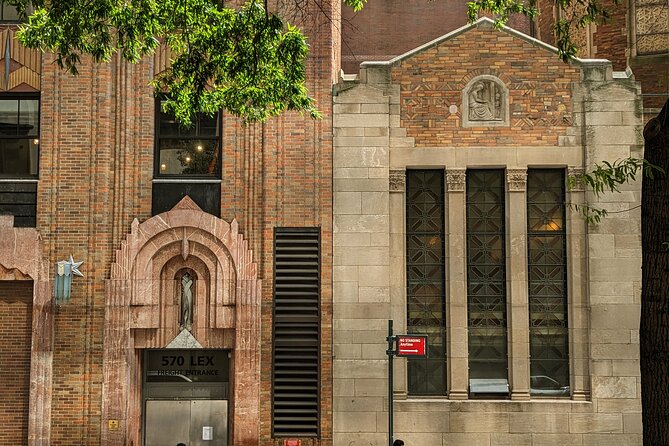
You begin at 810 8th Ave, near the boundary of Hell’s Kitchen and Times Square. This first stop is where you learn the tour’s vocabulary: the historic move uptown, architecture periods from Beaux-Arts drama to modern restraint, and the basics of zoning as a system.
This matters because zoning isn’t just paperwork—it’s why Midtown has the patterns it does. The guide uses the idea of Privately Owned Public Space to explain how the city often trades something (space, access, buildable area) for something else (a usable public environment). Once you get that, later stops stop feeling random.
You also start with public art embedded in the streetscape and program spaces, including works by Sidney Simon and Matt Mullican. Even if you don’t know those artists yet, you’ll learn how “public” art fits into private development plans.
Stop 2: 350 W 50th St—Matt Mullican under the city
Next you head to 350 W 50th St, tied to the subway station below Worldwide Plaza. The highlight here is the incised granite by Matt Mullican, part of a larger program where art becomes part of infrastructure—not a separate museum event.
This is a good moment to train your attention. Look at how the design changes when you move underground: surfaces, lighting, and the way people flow through space. Midtown architecture isn’t only vertical. It’s also how you experience the city when you’re moving between places.





CitizenM to the skyline scan: Times Square with a planner’s eye
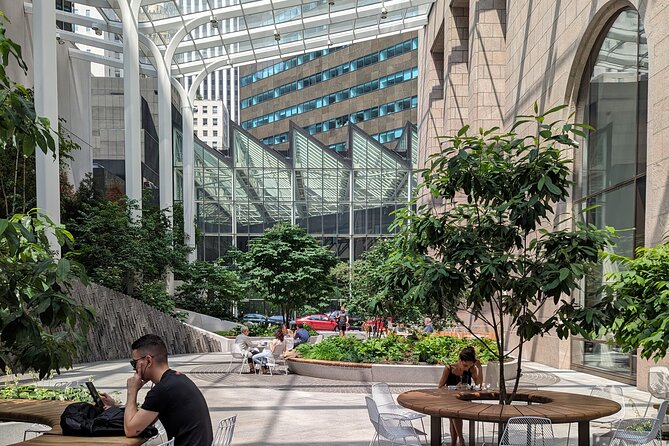
At the citizenM New York Times Square Hotel, you get a quick break from pure architecture talk and shift into skyline awareness. The guide encourages you to scan for landmarks like Hearst Tower and the New York Times Building, which turns a chaotic view into a map you can learn.
You’ll also notice oversized wall art by Julian Opie, the kind of work that feels like it belongs in the middle of advertising space. That’s the point: Midtown’s art often isn’t “quiet.” It’s meant to be seen at speed.
From there, the tour takes you to the area around the Allianz Building and Warner Music Group for a view of Times Square from the north. The story here is zoning and design choices that produced a look inspired by Tokyo—an example of how Midtown borrows and rebrands styles when it wants a certain urban energy.
The Brill Building: when culture crowds the blocks
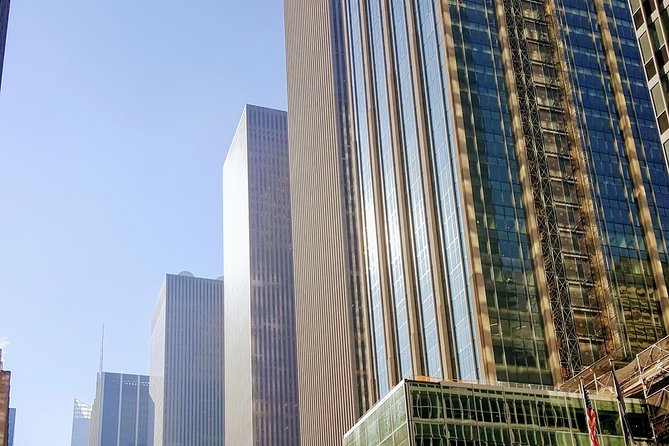
At the Brill Building, the tone shifts to cultural history. The guide uses the building to talk about how Times Square and much of Midtown functioned—then and now—as a near-monopoly on American culture in multiple formats: music, theater, radio, television, books, magazines, newspapers, advertising, and even automobiles.
This is one of those stops where you’ll likely rethink what you thought Midtown was “for.” It’s not only offices and hotels. It’s also a machine that helped distribute culture at mass scale. The architecture is the container; the industry is the story.
787 7th Avenue and corporate POPS: modern art inside power
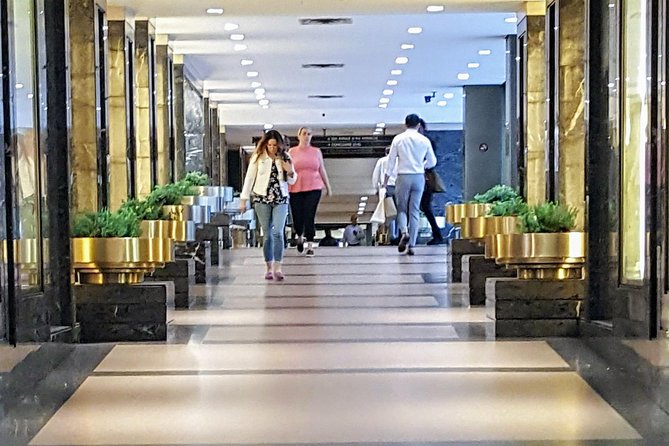
One of the biggest segments comes around 787 7th Avenue and nearby corporate spaces, with BNP Paribas used as the transitional point. You pass landmarks like the Winter Garden and the Taft Hotel, then shift into a corridor of corporate lobbies where architecture and art go together.
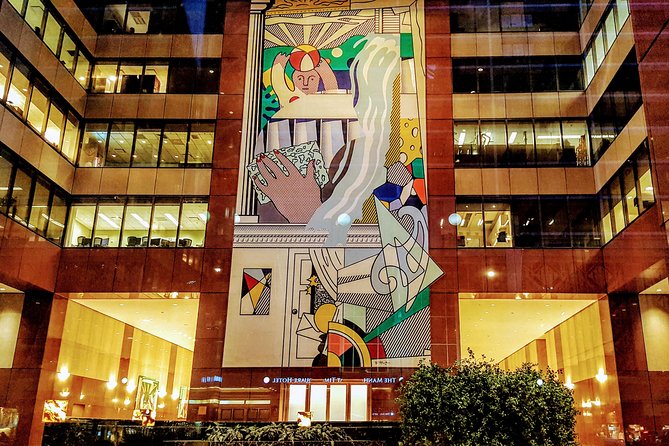
A key highlight is Roy Lichtenstein’s Mural with Blue Brushstroke, painted in place before the building opened. That timing matters: this is not art added later like an afterthought. It’s part of the building’s original design.
Then you step back out into POPS areas connected to the same complex, where you’ll see works by Sol LeWitt and Barry Flannagan. This is where the tour’s theme clicks: public-facing space inside private development becomes a stage for world-class modern art.
If you like architecture that shows off, this is your section. If you prefer less obvious art, this is still worth it because the guide teaches you what makes these pieces “work” in real urban space.
6 1/2 Avenue and the weird Midtown in-between
A short walk brings you to 6 1/2 Avenue, a mid-block arcade that doesn’t fully connect Times Square with Central Park. It’s a small thing on a map, but it’s a big thing for understanding Midtown’s logic: the city often creates micro-spaces that feel like accidental neighborhoods.
This stop also helps you learn how architects and planners use mid-block circulation—places you’d normally ignore when you only travel along major avenues. When you recognize these patterns, Midtown becomes easier to navigate on your own afterward.
UBS Art Gallery lobby: art in a space that changes day to day
At the UBS Art Gallery, you get another practical lesson: how art programming sits inside a financial ecosystem. The lobby is split between temporary and permanent exhibits, with artists including Frank Stella and Sarah Morris mentioned in the tour description.
You’re not getting a long museum visit here. You’re getting a short, focused orientation that helps you understand what to look for when you encounter high-end modern art in public-facing lobbies.
Time and Life building lobby: stainless steel meets Mondrian’s student
At 1271 Avenue of the Americas, the tour zeroes in on the lobby of the Time and Life building. It’s described as a modern classic with stainless steel panels and a terrazzo floor, plus wall art by Fritz Glarner, a student of Mondrian.
This stop is great if you like design details you can actually see without a microscope. Notice how materials and geometry create a mood. Then connect that mood back to the idea that corporate spaces often build their own brand through architecture.
Monumental POPS: Senju, Kan Yasuda, and La Gran Manzana
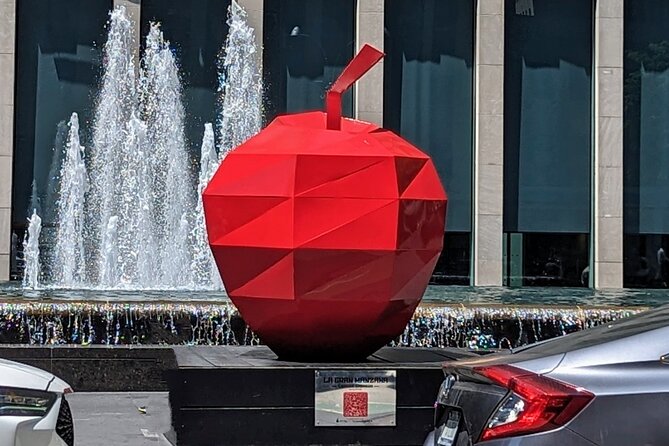
Right after, the theme shifts again to something big and physical: monumental works by Hiroshu Senju and Kan Yasuda, with La Gran Manzana on the plaza outside. This is where Midtown POPS can feel almost like an outdoor exhibition.
Even if you’re not an art specialist, the guide’s framing helps. You learn to treat these outdoor and semi-outdoor spaces as part of the architecture story, not decoration.
Sixth Avenue and Rockefeller Center: Art Deco transitions into modern
On Sixth Avenue (Avenue of the Americas), the tour stops at 1221 McGraw Hill to see a work by Mark Bradford. Then you move back outdoors near what’s described as Skyscraper Alley, a stretch called out for the results of zoning and what it can produce when design priorities get reduced.
Across the street is where the tour slows down for one of Midtown’s greatest skyline projects: Rockefeller Center. The guide explains the style evolution—from “Modernistic” (Art Deco) to more modern direction as the project progressed after Raymond Hood.
This is the kind of detail that makes a guided tour feel worth it. You’re not just admiring buildings. You’re noticing how planning decisions create visible shifts in aesthetics.
Radio City Music Hall: why roxy is everywhere
At Radio City Music Hall, you learn the origin story for the name Roxy as it relates to venues. It’s a quick stop, but it connects the idea of Midtown culture—the entertainment machine—to branding and naming that still shapes what you see today.
Then the tour points you back toward Rockefeller Center’s outdoor spaces, where art and architecture hit their peak.
The Rink and International Building: Light, Atlas, and winter spectacle
Outside at Rockefeller Center, you’ll see the rink area where the Christmas tree goes every year. The guide also shares history about the holdouts, a Diego Rivera connection with the Rockefellers, and the rink’s own reversal-of-fortune story.
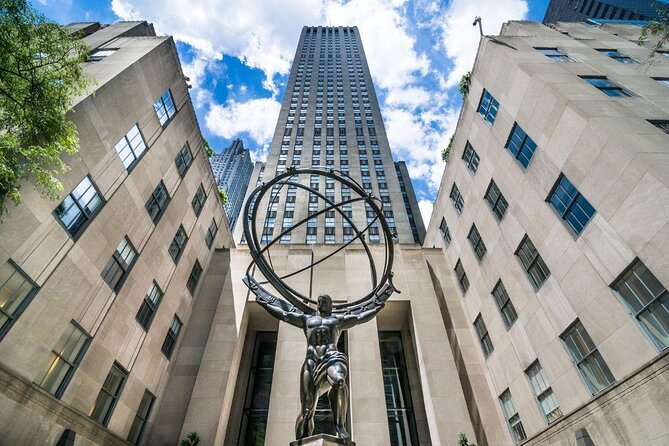
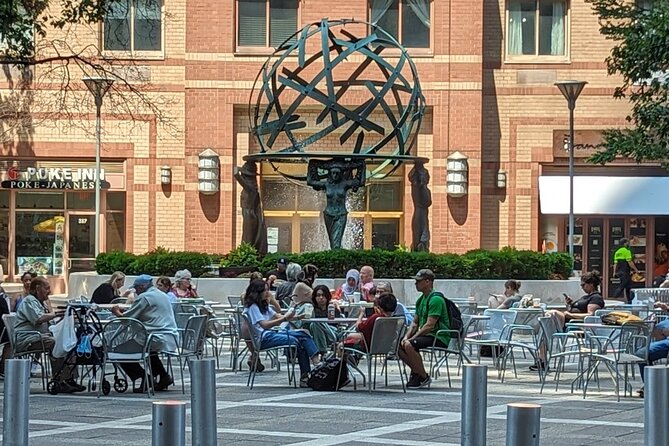
Then you move to Rockefeller Center, including the lobby of the International Building. The highlight here is Light and Movement by Michio Lhaza as wall center pieces, plus Atlas by Lee Lawrie facing St. Patrick’s Cathedral. It’s a strong ending to this section because you get the geometry and the symbolism together.
Even if you’ve walked past Rockefeller Center a dozen times, this framing makes it feel like a designed system rather than a tourist backdrop.
St. Patrick’s Cathedral and Fifth Avenue: architecture as a timeline
Next is St. Patrick’s Cathedral. The guide uses it and the surrounding Fifth Avenue building environment to explain how the avenue tells a history through its architecture.
A few blocks later, you get the juxtapositions toward Park Avenue, including the note that the Villard Houses are now the Palace Hotel. This is one of the tour’s favorite moves: show you how buildings change roles while keeping their architectural identity.
Park Avenue in one walk: from train tracks to major corporate icons
At Park Avenue, the tour covers the evolution from open train tracks to high-end residential to today’s corporate buildings. It’s not just a list of famous structures—it’s a story about how space got repurposed as Midtown’s needs changed.
The buildings discussed include:
- Health and Racquet Club (1918)
- St Bart’s (1919)
- New York Central Building (1929)
- Waldorf Astoria (1931)
- GE Building (1931)
- Lever House (1952)
- Seagram Building (1958)
- Met Life Building (1963)
If you like architecture, you’ll probably start spotting why those dates matter. They reflect shifts in materials, style, and ambition. If you’re not an architecture person, you’ll still get the takeaway: Midtown’s “feel” is the accumulation of design decisions stacked on top of earlier decisions.
Christie’s Sculpture Garden: zoning, sculpture, and three French names
At Christie’s Sculpture Garden (535 Madison Avenue), the tour calls it a hat trick for architecture and zoning. You also see works by three French artists spaced about 20 years apart: Léger, Dubuffet, and François-Xavier Lalanne.
This stop works because the art is placed outdoors but designed with the building environment in mind. You can treat it like a mini exhibition, then immediately tie it back to the POPS theme.
Papillon Bistro and Bar plus the Philip Johnson POPS story
The tour then passes Papillon Bistro & Bar, pointed out as a “successful holdout” in a high-pressure real estate zone. It’s a reminder that not every “great Midtown building story” is only about new construction. Some are about persistence and survival.
From there, you’re in the neighborhood of a Philip Johnson building with a recently redesigned outdoor POPS. The tour notes that if there’s time, you can go inside to see Solid Sky by Alicia Kwade. Even if you don’t get inside, you’ll see how outdoor public space becomes part of a building’s identity.
IBM POPS and the ending shift toward Billionaire’s Row
One more POPS highlight comes near the IBM Building, noted as one of the most highly rated in the city for its POPS, including pieces connected to Applefest. Then you wrap up at 244 5th Ave, exiting onto 57th Street under Billionaire’s Row.
The final image is skyline change: skinny residential towers and astronomical height and price points. It’s a fitting last moment because you started the tour learning how zoning and design rules shape what gets built. Now you finish by seeing the modern payoff—extreme vertical ambition.
Who this Midtown tour is best for
This walk is ideal if you like your city sightseeing with a reason behind it. You’ll enjoy it most if you’re the type who:
- notices materials, silhouettes, and how streets connect to buildings
- wants to understand POPS and why public space appears in private developments
- likes architecture and modern art without needing a museum ticket every hour
It’s also a smart choice if you’ve been to Midtown before and felt like you were only skimming the surface. The tour doesn’t just show famous places; it explains why less obvious passageways and lobbies matter.
If you hate walking, this may feel like too much. But if you’re fine with steady Midtown steps and short stops that keep your attention, it’s a strong match.
Should you book: my quick recommendation
I’d book this tour if you want a Midtown experience that teaches you how to read the city you’re already looking at. The small group size, the POPS-focused storytelling, and the way the guide connects architecture to art and zoning are the big reasons the experience earns a near-perfect rating.
If you’re mainly in Midtown for quick photos and minimal walking, you might not love it. But if you want to come away with a “now I see it” understanding of why this part of Manhattan looks the way it does, this is a solid use of $59.
FAQ
How long is the Midtown Manhattan Art and Architecture Walking Tour?
It runs about 2 to 3 hours.
Where does the tour start and end?
The tour starts at 810 8th Ave, New York, NY 10019 and ends at E 57 St & 5 Av (east of Tiffany’s on 57th Street), New York, NY 10022.
What’s the group size limit?
The tour has a maximum of 5 travelers.
Is the tour offered in English, and do I need a printed ticket?
The tour is offered in English and uses a mobile ticket.
Do I need to pay admission at each stop?
The tour description lists multiple stops with admission tickets free, and the overall price includes the professional guide.
Does the tour run in bad weather?
It operates in all weather conditions, but it can be canceled due to poor weather, with options offered if that happens. Dress appropriately for the weather.
Is there free cancellation?
Yes. You can cancel up to 24 hours in advance for a full refund.