REVIEW · NEW YORK CITY
Wall Street to Chinatown: Dumplings & Taro bites walking tour
Book on Viator →Operated by The Daily Trips · Bookable on Viator
Finance meets dumplings in three hours. This walking tour strings together major Wall Street landmarks with a guided stroll into Chinatown, ending with two focused Chinatown bites: taro munchkins at Ali Mama and dumplings at Tasty Dumpling.
I love the small group size (capped at 10), which makes it easier to ask questions and get a human, story-led route from guides like Robert or Muhammad. I also love that the included tastings are specific and satisfying, not vague. The only real consideration: it’s around three hours of walking in Lower Manhattan, so comfort matters.
In This Review
- Key things I’d watch for
- A tight 3-hour route that links money, streets, and snacks
- Charging Bull and Trinity Church: the Wall Street warm-up
- The NYSE, Federal Hall, and the Fed: iconic fronts with real meaning
- St. Paul’s Chapel: a small building that carries big weight
- Columbus Park and Chinatown: from Five Points to today’s street life
- Ali Mama taro munchkins: the snack that changes your texture expectations
- Tasty Dumpling: crispy bottoms, chewy wrappers, and a sauce decision
- How the group of 10 changes the tour experience
- Timing and walking reality: it’s a short tour, but not a sit-down one
- Price and value: what $119 buys you
- Who should book this tour (and who might skip it)
- Should you book Wall Street to Chinatown: Dumplings & Taro bites?
- FAQ
- How long is the Wall Street to Chinatown walking tour?
- How large is the group?
- What language is the tour offered in?
- What food is included in the tour price?
- Where do I meet, and where does the tour end?
- Do the landmark stops require paid admission?
- What is the cancellation policy?
Key things I’d watch for
- A capped group of 10 keeps the pace conversational instead of rushed.
- Wall Street monuments first, Chinatown food last gives you a satisfying before-and-after feel.
- Two included tastings means you’re not hunting for lunch on an empty stomach.
- Free admission at the major stops lets you spend your money on guiding, not ticket lines.
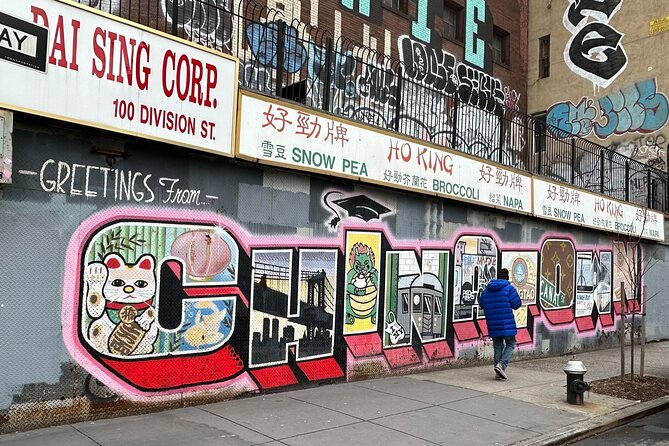
- Five Points context in Chinatown gives the neighborhood more meaning than a quick photo stop.
A tight 3-hour route that links money, streets, and snacks
This tour works because it doesn’t treat New York like a checklist. You start in the Financial District, where symbols of global finance sit in very public places, and you finish in Chinatown, where the day-to-day energy is all about food, markets, and community. In between, your guide helps connect the dots—why these buildings matter, and how the neighborhood you’re walking into got shaped by earlier waves of New Yorkers.
At about three hours, you get a lot without feeling like you’re gone all day. It’s also a good length for first-timers who want structure but still like to move at a human pace.
And yes, the food stops are the payoff. You’ll taste Chinatown specialties that lean into taro and dumplings, with the kinds of textures that make you slow down and actually pay attention.
You can also read our reviews of more walking tours in New York City



Charging Bull and Trinity Church: the Wall Street warm-up
You kick off at Charging Bull in Bowling Green Park. The sculpture is a big one—bronze, about 11 feet tall, and well over 7,000 pounds—and it has become a quick ritual spot. The classic good-luck behavior is rubbing the horns, and you’ll likely see plenty of people doing it on your walk-in. Even if you’re not into statues, it’s a fun way to break the ice and understand why Wall Street culture has its own weird little traditions.
Right after that, you hit Trinity Church Wall Street at the intersection of Wall Street and Broadway. This is a Gothic Revival landmark completed in 1846, and it feels like a pause button in the Financial District. You’ll notice the soaring spire and the stained glass vibe, plus a historic cemetery that includes Alexander Hamilton. That detail alone changes how you look at this area: you’re not just seeing corporate buildings, you’re seeing layers of government, founding-era names, and long-lived institutions.
Practical note: both stops are free and quick (around 15 minutes each), so the value here is what your guide points out—what to notice beyond the obvious.
The NYSE, Federal Hall, and the Fed: iconic fronts with real meaning
Next comes the New York Stock Exchange. Even from the outside, it’s dramatic: Corinthian columns, a grand facade, and the pediment sculpture titled Integrity Protecting the Works of Man. It’s one of those places where a photo tells you what it looks like, but your guide helps explain why it became a symbol in the first place. And because it’s the NYSE, people naturally drift toward the steps for pictures—so expect some sidewalk flow around you.
Then you move to Federal Hall at 26 Wall Street. This one lands differently. It’s the site where George Washington took the oath of office as the first President in 1789, and the building now serves as a National Memorial. If you’ve ever wondered why the Financial District feels like a mix of power and paperwork, Federal Hall is the reminder that the U.S. story started right here too—government didn’t spawn in a vacuum.
After that, you’re at the Federal Reserve Bank of New York. The architecture is fortress-like, inspired by Italian Renaissance palaces, and it’s tied to monetary policy and financial stability. You’ll get context around the role of the Federal Reserve and how the financial system works, including the fact that it’s known for housing one of the largest gold reserves in the world. Even if your visit time is brief, this stop helps you translate what you hear in the news into something you can picture on the ground.
St. Paul’s Chapel: a small building that carries big weight
St. Paul’s Chapel is the kind of place you either walk past quickly or remember for years. It’s the oldest surviving church building in New York City, completed in 1766. The architecture is Georgian, and it has a reputation as the Little Chapel That Stood for surviving the collapse of the Twin Towers just blocks away after 9/11.
On this tour, it’s not treated like a random historic stop. You’ll get the sense of why it became a site of remembrance and reflection, not just a pretty church. It also gives your walk a more human temperature shift after the heavy finance stops. You’ll notice the contrast the moment you step into the calmer atmosphere.
Columbus Park and Chinatown: from Five Points to today’s street life
From Wall Street, the tour heads toward Columbus Park in Manhattan’s Chinatown. This is not just a break in the walking—it’s a location with layers. The park sits on ground that used to be part of the notorious Five Points neighborhood, an area known for extreme poverty, overcrowding, and a dense mix of immigrant life, along with gang activity and tenements.
Once you learn the context, Columbus Park becomes more than a green space. It’s a community spot where locals play mahjong, practice tai chi, and enjoy live music. That local scene matters because Chinatown here isn’t just an attraction. It’s an everyday neighborhood where people still use public space in cultural ways.
Then you spend time in Chinatown, with the Five Points story in your head. Your guide helps connect the name Five Points to the five-way intersection that once existed in the area—Anthony, Orange, and Cross Streets—later corresponding to Worth, Baxter, and Mosco Streets. Even if you’re not a history person, having those street anchors gives you something concrete to hold onto while you walk through modern Chinatown blocks.





Ali Mama taro munchkins: the snack that changes your texture expectations
Now for the food payoff: Ali Mama for taro munchkins. These are mochi donuts with a crispy exterior and a creamy taro filling. The taro flavor is described as rich and earthy, with a slightly sweet finish. The best way to think about them is texture first, flavor second—in a good way.
You’ll likely find yourself noticing the contrast: crispy outside, chewy inside, custard that feels thick and smooth. Taro isn’t like typical vanilla or chocolate sweetness, so it’s a nice change if you’re used to desserts that just taste sweet.
Since this tasting is included, you don’t have to budget extra just to get a meaningful snack. And it’s a smart choice for a walking tour, because you get something you can eat while staying on the move.
Tasty Dumpling: crispy bottoms, chewy wrappers, and a sauce decision
Next is Tasty Dumpling. This is the classic dumpling stop where quality shows up in the wrapper texture. You’ll be looking for dumplings with crispy, golden bottoms and soft, chewy wrappers. The filling is described as juicy and flavorful, with options like pork and chive or a veggie choice depending on what’s available.
Sauce matters here. You’re set up to drizzle with soy sauce or vinegar, which is exactly how you turn a good dumpling into a great dumpling. The vinegar also helps cut through the richness, so you don’t end up with that heavy, stuffed feeling too fast.
Because this tasting is included as part of the tour, you get a full, centered dumpling experience rather than a quick bite you regret later.
How the group of 10 changes the tour experience
A group capped at 10 travelers is the difference between hearing facts and actually having a conversation. It also helps with timing: your guide can keep an eye on the whole group, and you’re less likely to get stuck behind a slow-moving cluster.
The reviews you’ll hear about this style of tour often mention guides being friendly and funny, and that matches what makes a walking tour work. If you’re lucky, you get a guide like Robert who keeps the pace light and the information practical, or Muhammad who’s described as well-organized and personal. Either way, you’re spending your time with someone who knows how to connect the landmarks to what you’ll see next.
The tour also uses a mobile ticket, and it’s offered in English. That makes check-in simple and reduces the friction that can ruin the first 20 minutes of a walking day.
Timing and walking reality: it’s a short tour, but not a sit-down one
You’re looking at about three hours total, with short stops (often around 15 minutes) plus time in Chinatown. That structure is great because it keeps the momentum. But it also means you won’t get a long, slow museum-style experience at every location.
So if you want lots of sitting, reading, and lingering, you might find some stops move fast. Your best strategy is to treat this as an orientation tour: you’re learning what the places are and why they matter, so later you can return and spend more time where you want.
Comfort tip: you’ll walk through dense Lower Manhattan sidewalks and public plazas. Wear shoes you trust, and plan for weather since most of the experience is outdoors.
Price and value: what $119 buys you
At $119 per person for about three hours, you’re paying for three things at once:
- A guided route through two distinct areas—Financial District and Chinatown
- Meaningful interpretation at key landmarks
- Two included tastings: taro munchkins and dumplings
A lot of the landmark stops are admission ticket free, which shifts the value away from entrance fees and toward the guide’s storytelling and navigation. If you were to do this on your own, you’d still see the landmarks, but you’d miss the connections—like the significance of Federal Hall and what the Federal Reserve does, or the Five Points street layout behind modern Chinatown.
This is also a good price for people who don’t want to plan. The meeting point is in the Bowling Green area, and you end in Chinatown, so you get a natural flow without map-spaghetti.
That said, if you already know the history well and you mainly want food, you could potentially recreate parts of the route cheaper. But for most first-timers, the combination of guided context plus two solid tastings makes the price feel fair.
Who should book this tour (and who might skip it)
I’d book this if you want a single outing that mixes landmarks and food without turning into an all-day project. It’s also a strong choice if you’re visiting for the first time and want to understand why Wall Street looks the way it does, then walk straight into Chinatown with context in your head.
It’s less ideal if:
- You hate walking through busy city blocks
- You prefer long, quiet indoor time at a smaller number of sites
- You want heavy time at just one neighborhood instead of both
Food note: the dumpling stop is said to include pork and chive or a veggie option, but the provided info doesn’t mention allergy accommodations. If you have strict dietary needs, you should plan to ask what’s available before you commit.
Should you book Wall Street to Chinatown: Dumplings & Taro bites?
Yes, if you like your city days to have a narrative arc. Starting at Charging Bull and moving through Trinity Church, Federal Hall, the Federal Reserve, and St. Paul’s Chapel gives you a clear sense of how power and public life shaped this part of Manhattan. Then Chinatown feels like a real continuation, not a separate activity—especially once the Five Points context is in play.
You’ll leave with two included food wins (Ali Mama taro munchkins and Tasty Dumpling), and you’ll have a guided route that helps you notice things faster than if you were wandering alone. If you’re comfortable walking and you want a fun, structured taste of both neighborhoods, this is a strong bet.
FAQ
How long is the Wall Street to Chinatown walking tour?
It’s about 3 hours.
How large is the group?
The tour has a maximum of 10 travelers.
What language is the tour offered in?
It’s offered in English.
What food is included in the tour price?
You’ll taste taro munchkins at Ali Mama and dumplings at Tasty Dumpling.
Where do I meet, and where does the tour end?
It starts at Bowling Green (Bowling GreenPX3P+XG, New York, NY 10004, USA) and ends in Chinatown, New York, NY.
Do the landmark stops require paid admission?
The tour lists the stops as admission ticket free.
What is the cancellation policy?
You can cancel for a full refund up to 24 hours before the experience starts. If you cancel less than 24 hours before, you don’t get a refund.